Modern Warships: Naval Battles
- 4.5
- Rating
- 50.00M
- Installs
- Free
- Price
 Analysis by App-foxy
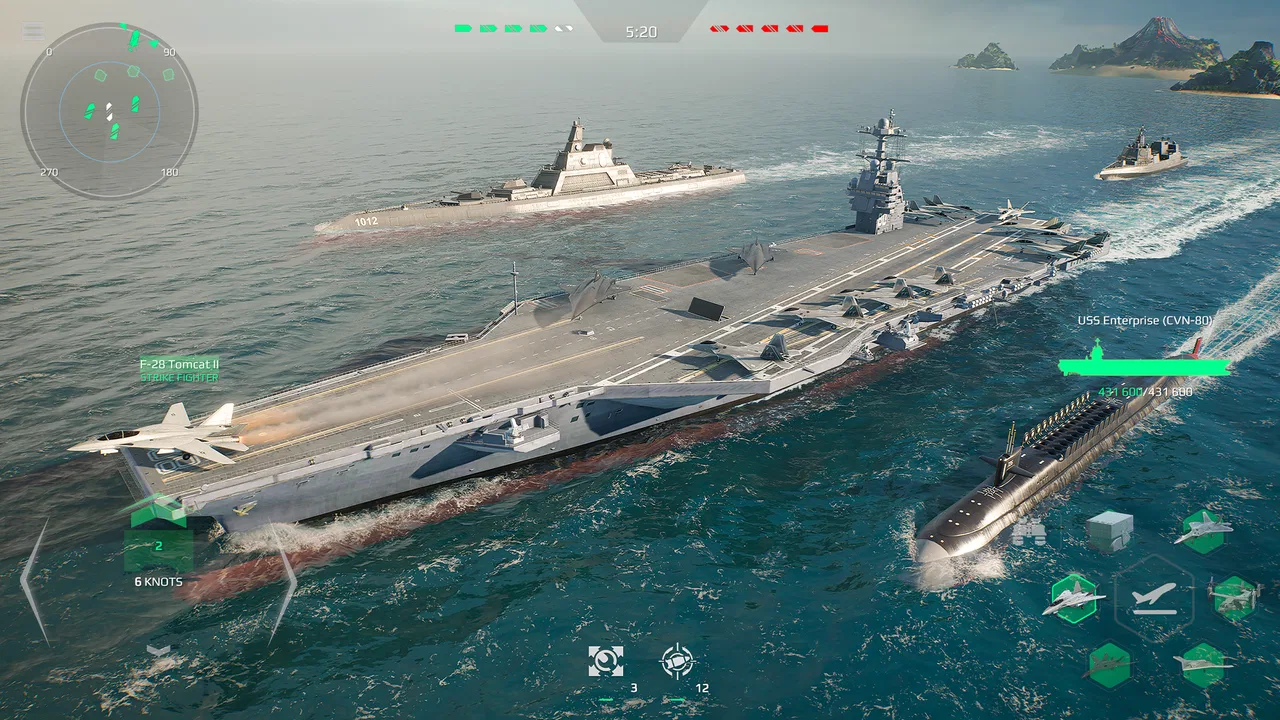
I spent time with Modern Warships: Naval Battles as a mobile action game built around online naval combat, and my first impression was that it aims for a more serious military feel than the average quick-fire shooter. You are not running through corridors with a rifle; you are managing a modern warship, reading the battlefield, choosing targets, and trying to make every attack count while the match keeps moving around you. That change of scale gives the game its personality.
It is developed by Artstorm FZE and available as a free game for Android and iOS. The store places it in the action category, with an age rating of Everyone 10+. Its popularity is easy to understand: it has passed 10 million installs, carries a 4.6 average from around 880 thousand ratings, and has about 17 thousand written reviews. Those figures suggest a large audience, but they do not automatically make it right for every player. The important question is whether you enjoy deliberate vehicle combat enough to accept its learning curve and online demands.
How the naval battles feel in everyday play
The pace is faster than the subject matter might suggest. A large ship sounds slow and cumbersome, yet a match still asks for quick decisions. I found myself switching attention between movement, enemy positions, weapon timing, and the changing shape of the fight. The game does not feel like a relaxed sailing simulator. It is closer to an action shooter where the vehicle itself becomes your character.
You May Also Like

 Blood Strike: 2.5 Anniversary
Blood Strike’s Loadouts Turn Every Drop Into a Tactical Gamble
A close look at Blood Strike’s custom loadouts: how fast access to signature weapons reshapes its battle royale rhythm, rewards preparation, and narrows the gap between fights.

 Pandora - Music & Podcasts
Pandora’s Music Is Easy to Start, but Harder to Recover
Pandora’s strength is its low-effort path from a seed to a station. Its weak spot is how much confidence it asks you to place in connection, setup, and quiet recovery.

 8 Ball Pool
 Is Built on Rivalries, Rematches, and Routine
A close look at the rivalries, rematches, shared routines, and unanswered safety questions that turn a quick pool match into a persistent mobile community.

 Samsung Music
’s Quiet Strength Is Playing What You Already Own
Its reach comes less from spectacle than from dependable access to a personal library. That simplicity is both the app’s strongest retention engine and its ceiling.

 AccuWeather: Weather Radar
AccuWeather Review: A Quick, Clear Forecast for Everyday Decisions
For everyday plans, the best forecast is the one you can understand quickly. AccuWeather makes rain timing, radar, and local conditions easy to act on, with a few trade-offs.

 Hill Climb Racing
Why Hill Climb Racing Still Turns Crashes Into One More Run
A tiny car, a bumpy hill and one more upgrade: Hill Climb Racing keeps resurfacing because its simple chaos makes every near-miss feel personal.
More From Our News Desk



That distinction matters when comparing it with more familiar mobile alternatives. A conventional military shooter usually rewards aiming reflexes and movement through compact spaces. Here, positioning carries more weight. A poor approach can leave the ship exposed, while a cautious route may give me a better angle for the next attack. The result is a slower kind of tension: I am not constantly sprinting, but I am rarely free to stop thinking.
The opening period can feel busy because several ideas arrive together. I had to learn how much space a ship needs to turn, how quickly danger can develop, and when attacking is less sensible than preserving a useful position. New players who expect an instant arcade experience may initially find the controls and battlefield awareness demanding. I recommend treating the first sessions as practice rather than judging the game by the first few minutes.
A useful habit is to avoid chasing every visible opponent. In a naval battle, pursuit can pull the ship away from cover or from teammates who need support. I got better results when I watched the wider fight and asked which target could be attacked safely, rather than simply selecting the nearest enemy. This is one of the game’s less obvious strengths: it rewards restraint without becoming a purely slow strategy title.
For a normal evening session, the game fits best when I have enough time to settle into several battles. It is possible to play in short bursts, but the online format means I cannot always pause at a convenient moment. If I only have a few spare minutes while waiting for transport, a single-player action game is a safer choice. If I have a clear block of time and want competition that feels more substantial than a tap-heavy arcade game, the naval format works well.
What makes the speed feel different
Perceived speed depends on more than how quickly the ship moves. Camera movement, incoming attacks, enemy visibility, and the time needed to rotate or reposition all affect how urgent a match feels. Modern Warships balances these elements so that a vessel can feel powerful without making the player completely passive. I still had time to plan, but mistakes could become serious before I had fully corrected them.
This also creates a trade-off. Players who enjoy rapid respawns and constant close-range action may find the naval rhythm too measured. On the other hand, players who dislike twitch aiming may appreciate having more time to read the situation. The game occupies a middle ground between a reflex shooter and a vehicle strategy game, and its appeal depends heavily on where your preference sits.
There is also a difference between visual speed and practical speed. A ship may appear to be advancing quickly, yet reaching the useful firing position can take patience. I learned to think one move ahead: if I turned toward a target too late, the ship’s momentum and turning space could make the attack awkward. Planning the approach before the enemy entered the ideal range was more valuable than reacting at the last second.
Heavy-use moments and what they reveal
The busiest moments arrive when several ships are active around the same area. At that point, the screen can become information-heavy, with movement, effects, targets, and weapon activity competing for attention. I found that these moments test my decision-making more than my raw reaction speed. The best response was usually to simplify the situation: choose one priority, keep the ship moving sensibly, and avoid wasting attacks on targets that were unlikely to be finished.
Longer sessions also expose the game’s resource demands more clearly than a quick test. A modern 3D naval battle naturally asks more from a phone or tablet than a basic puzzle or two-dimensional arcade game. I would expect older or entry-level devices to offer a less comfortable experience, especially when the battlefield becomes crowded. The minimum operating-system requirement is Android 7.0, but software compatibility alone does not guarantee that every device will feel equally smooth.
On a stronger device, the experience is more convincing because the ships and battlefield have room to communicate scale. On a weaker one, reducing visual ambition would be preferable to forcing the phone to struggle. I would start with conservative graphics settings if the game offers them on my device, then raise quality gradually. That approach is more useful than assuming the highest setting is automatically best.
Heat and battery use are practical concerns for this kind of game, even when the exact result varies by device. During heavy play, I would avoid gaming while the phone is already warm, especially inside a thick case or under direct sunlight. A cooler device is more likely to remain comfortable and responsive. I also prefer playing near a reliable charger rather than beginning a long session with a nearly empty battery.
One of my more useful routines was to separate learning sessions from competitive sessions. When I was testing movement or trying to understand a ship’s handling, I accepted mistakes and concentrated on one lesson. When I wanted a better result, I used what I had learned instead of experimenting with several unfamiliar choices at once. This reduced frustration and made progress feel more deliberate.
Reliability depends on the whole setup
Because this is a PvP game, reliability is not only about whether the app opens. The quality of the connection matters, and a moment of instability can affect aiming, movement, or the timing of an attack. I found that a dependable Wi-Fi connection is preferable for serious matches. Mobile data can be convenient, but signal changes and crowded networks may make the experience less predictable.
The game’s online nature also changes how I think about recovery. If a battle goes badly, I cannot simply rewind it or reload an earlier save. Recovery means adjusting my approach in the next match: taking safer positions, learning from a missed opportunity, or changing how aggressively I pursue targets. That can be satisfying because improvement feels earned, but it may frustrate anyone who wants a forgiving offline experience.
When performance feels inconsistent, I would first check the simple causes rather than immediately blaming the game. Closing other demanding apps, restarting the device, moving to a stronger connection, and allowing the phone to cool can all help establish whether the problem is local. These steps do not transform weak hardware into a gaming device, but they make the experience easier to judge fairly.
I also appreciate that the game’s large audience gives it a sense of longevity. A title with more than 10 million installs is less likely to feel like a forgotten experiment, and the substantial rating activity indicates that many players have spent enough time with it to form an opinion. Still, a large player base does not remove the normal online-game frustrations: matches can be uneven, losses can feel abrupt, and progress may require patience.
That patience becomes especially important because the game is free to download but includes in-app purchases ranging from $0.99 to $199.99 per item. I would approach the purchase system carefully. The sensible way to evaluate the game is to decide first whether the core battles are enjoyable without spending, then set a personal limit before buying anything. A large optional purchase can be difficult to justify if I am still unsure whether I will keep playing.
Device constraints and practical expectations
The listed Android requirement is version 7.0 or later, which makes the game accessible to a broad range of software versions. Hardware is the more important practical question. A phone that handles simple games comfortably may still struggle with a visually demanding multiplayer battle, particularly when it has limited free storage, an aging battery, or a processor designed mainly for everyday apps.
I would give the game more room to breathe than I would give a casual title. Keeping the operating system updated, closing unnecessary background activity, and avoiding a nearly full device are sensible preparations. If the phone becomes hot quickly, I would shorten sessions or lower the visual load rather than continuing until controls feel delayed. Comfort is part of performance, especially in matches where small timing errors matter.
Screen size affects the experience too. A larger display makes it easier to read the battlefield and distinguish targets, while a smaller phone can make the interface feel crowded during intense encounters. That does not make a compact device unusable, but it may reward a more careful play style. Tablets can be appealing for visibility, provided their hardware and connection are suitable for the game.
I would not choose this title primarily for offline travel. Its identity is tied to competitive naval battles, so a stable connection and enough time for an uninterrupted match are important parts of the experience. For commuting through unreliable coverage, an offline action game or a turn-based alternative would be more dependable. Modern Warships is better suited to home Wi-Fi, a strong mobile signal, or another setting where interruptions are unlikely.
Players should also consider how they feel about repeated competition. The game can provide a clear reason to return because every battle offers another chance to improve positioning and timing. But that same loop can become tiring if I am looking for a story campaign, a relaxed sandbox, or a game that lets me progress entirely at my own pace. The naval theme is distinctive, yet the online structure remains central.
Who will enjoy it most
I would recommend it to someone who likes military vehicles, competitive matches, and learning a system through repeated play. It is particularly suitable for players who enjoy making tactical choices while still wanting direct control. The strongest audience is not necessarily expert shooter players; it is people who find satisfaction in combining observation, positioning, and timing.
It can also work for friends who want a shared action game with a different visual identity from the usual character-based shooters. The ships give each encounter a broader sense of space, and the battlefield encourages players to think about routes and exposure rather than only personal aim. If you enjoy discussing what went wrong after a match, there is enough decision-making here to support that kind of conversation.
I would suggest skipping it if you need a fully offline game, dislike competitive losses, or own a device that already struggles with demanding three-dimensional titles. I would also look elsewhere if your ideal naval game is a calm simulator focused on exploration and sailing. This is a combat-first experience, and its appeal comes from pressure, targets, and the need to respond to other players.
The age rating of Everyone 10+ makes it a reasonable option for younger players who meet the platform’s guidance, but parents should still remember that it is an online action game with optional purchases. I would explain the spending controls before handing it to a child and make sure the device is configured appropriately. The rating describes suitability, not a promise that every match will feel gentle or relaxed.
Small habits that improve the experience
My first practical tip is to learn movement before focusing on damage. A ship that is badly positioned can lose the chance to attack, retreat, or help an ally. Spend early matches watching how turns affect the next few seconds, and avoid making sharp changes merely because an enemy appears. Understanding the vessel’s space is more useful than memorizing a single aggressive opening.
Second, decide what your target priority is before the fight becomes chaotic. The most visible ship is not always the most important one. I found it helpful to ask whether an attack will remove an immediate threat, protect my route, or create an opening for the team. This simple filter prevents a lot of wasted attention and makes the match feel less random.
Third, use performance as feedback. If the device begins to heat up or controls feel less responsive after extended play, treat that as a signal to pause and cool down. A short break can be more valuable than forcing another battle while tired hardware and tired decision-making are working together against me.
Finally, keep purchases separate from frustration. Losing several matches can create the temptation to spend in search of a quick improvement. I would only buy something after deciding that I genuinely enjoy the game’s core loop and understand what the purchase changes. The free entry point makes that test possible, so there is no reason to rush it.
My performance verdict
Modern Warships: Naval Battles succeeds because it gives mobile action combat a clear identity. The ships make every decision feel larger, and the combination of movement, positioning, and weapon timing creates more depth than its simple premise might suggest. I enjoyed the moments when a careful approach worked better than a reckless attack, especially after I stopped treating every visible enemy as an immediate target.
Its limitations are equally clear. The online PvP structure demands a dependable connection, the visual workload may challenge older devices, and the learning curve can make the opening sessions feel less welcoming than a conventional arcade shooter. Optional purchases also mean that players should establish spending boundaries early. None of these issues ruins the game, but they do define who will enjoy it.
The current version is 0.101.0.120516242, and the game was released on May 13, 2021. Those details place it as an established mobile title rather than a brand-new experiment, while the continuing audience gives it a strong reason to remain on a player’s shortlist. I would install it free first, test it on my own device over several matches, and judge the connection and heat before considering any purchase.
My final recommendation is straightforward: choose it if you want modern naval combat that feels active but not purely reflex-driven, and if your phone and network can handle sustained online play. Choose a conventional shooter for faster close-quarters action, or an offline game for reliable travel sessions. For me, the game is at its best when I have a stable connection, a cool device, and enough time to think before firing. It is a strong choice for patient action players who want their battlefield decisions to matter.
FAQs for Modern Warships: Naval Battles
01What are the key features of Modern Warships: Naval Battles?
Modern Warships: Naval Battles offers an immersive naval combat experience with realistic graphics and physics. Players can engage in dynamic battles using a fleet of customizable ships. The game includes various modes such as PvP battles, and features an array of modern naval vessels, including aircraft carriers, submarines, and destroyers, each with unique capabilities.
02Is Modern Warships: Naval Battles free to play?
Yes, Modern Warships: Naval Battles is free to download and play. However, it includes in-app purchases that allow players to acquire additional ships, upgrades, and resources. While these purchases can enhance gameplay, they are not necessary to enjoy the full experience of the game.
03What are the system requirements for Modern Warships: Naval Battles?
To play Modern Warships: Naval Battles on Android, you need a device running Android 5.0 or higher with at least 2 GB of RAM. For iOS, an iPhone or iPad with iOS 11.0 or later is required. A stable internet connection is also necessary to participate in online battles and updates.
04Does Modern Warships: Naval Battles support multiplayer modes?
Yes, the game supports multiplayer modes where players can engage in real-time PvP battles with others from around the world. The multiplayer aspect is a significant part of the game, allowing players to test their strategies and skills against other naval enthusiasts.
05How often does Modern Warships: Naval Battles receive updates?
The developers of Modern Warships: Naval Battles regularly release updates to enhance gameplay, add new content, and fix bugs. These updates often include new ships, weapons, and features, ensuring that the game remains engaging and fresh for players. Keeping the game updated is recommended for the best experience.
Pros
- Stunning graphics enhance gameplay.
- Realistic ship models add immersion.
- Wide variety of naval vessels.
- Frequent updates with new content.
- Intuitive controls for smooth play.
Cons
- Requires stable internet connection.
- In-app purchases can be costly.
- Occasional matchmaking issues.
- High battery consumption.
- Can be demanding on older devices.

Modern Warships: Naval Battles
Gallery